
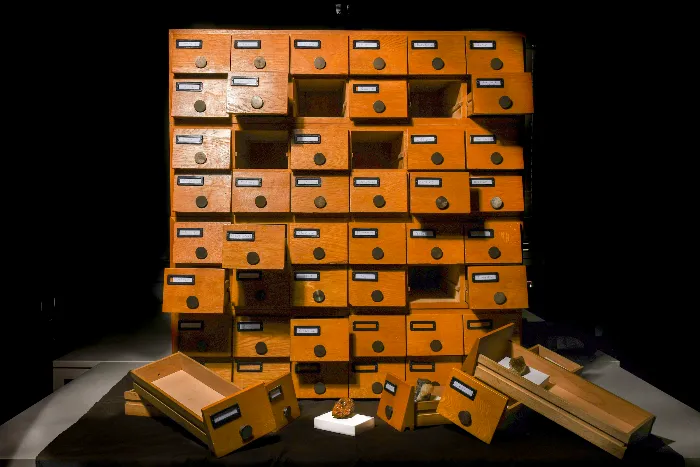
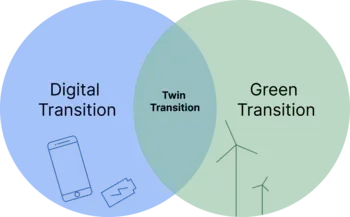
By making these chunks of Earth tangible, the Library highlights their links to both people and the planet, prompting policymakers, researchers, designers, engineers, and the public to confront the social and environmental impacts of our shift toward digitalisation and clean energy.
Gallery

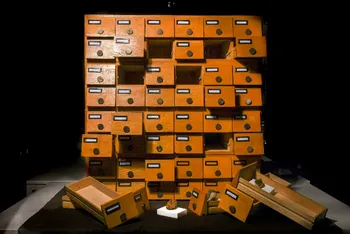
This is the materials library
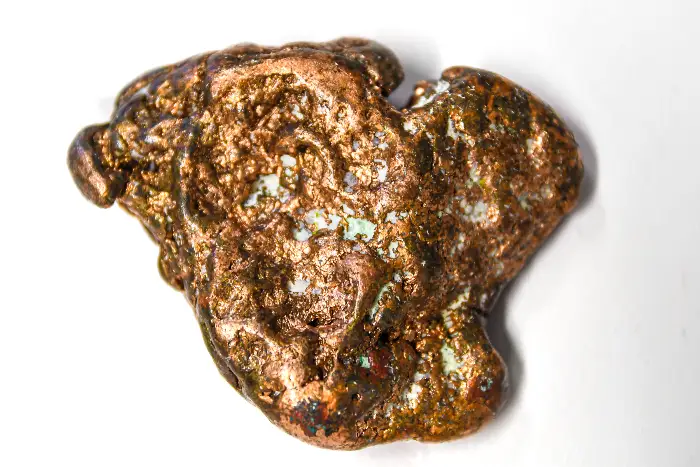
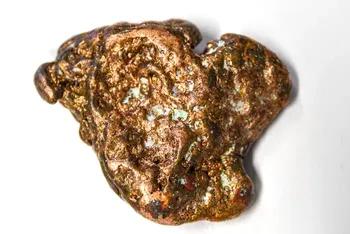
This is a copper sample from the materials library
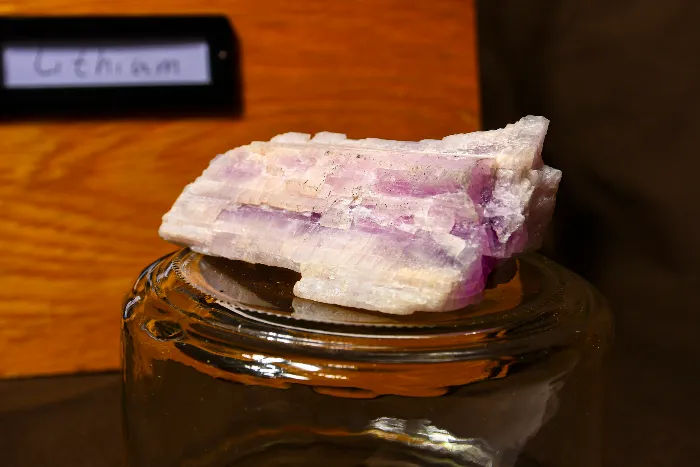
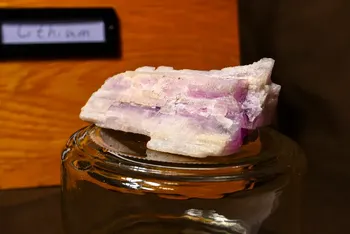
Lithium sample from the materials library.

Magnesium sample from the materials library.
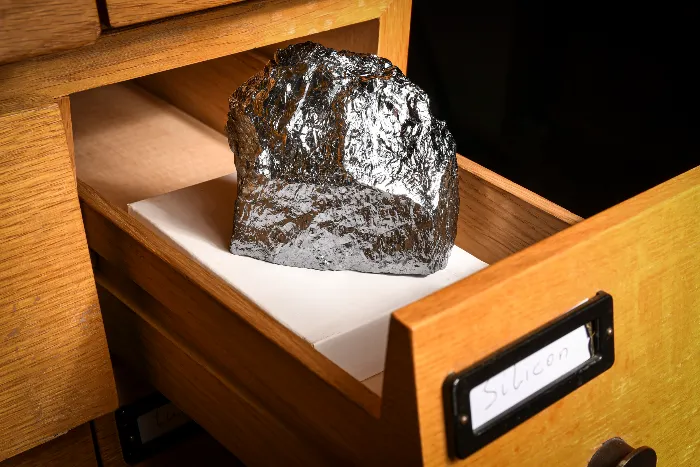
Silicon sample from the materials library.

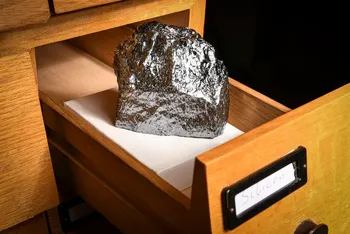
The Digital Materials Library of Stones
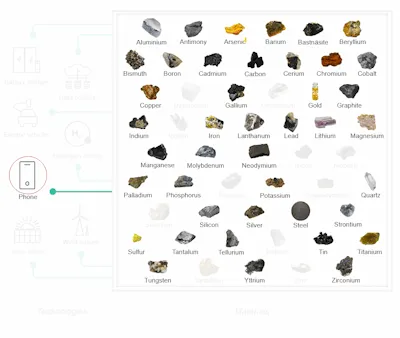
The Digital Materials Library of Stones brings online the more than 40 minerals of the physical Library and adds the ones that are impossible to physically store in the cabinets.
Instead of organising entries by chemical family, each mineral profile will answer key questions: How rare or critical is it? Which ore yields it?—and then link that mineral to the technologies that rely on it.
Earth is inseparable from the code that animates it. Every street, supply chain, social feed and climate model is a code/space—It’s like a web where digital code and physical materials are in constant dialogue, each one shaping and creating the other.
Our friendships and conversations are shaped by social media platforms; our money and markets run on lightning-fast trading programs; and we even use big computer models to predict how our actions today will impact the planet tomorrow.
Yet the digital is always physical. Each swipe and simulation is underwritten by kilometres of optical fibre, megawatts of electricity and tonnes of stones. The environmental imprint of the cloud infrastructure shows that digitalisation’s light and floating depiction is always set within mines, wells, power plants, and energy grids that extract resources and keep everything running.
Materials
A mineral is a naturally occurring, inorganic solid whose atoms are locked into a specific crystalline structure by aeons of heat, pressure, and chemical reactions. Minerals almost never show up as pure, single chunks. Instead, they’re mixed together in rocks. When the concentration of one or more valuable minerals in a rock formation is high enough to justify mining and processing, the rock becomes “ore”.
If metal prices fall or quality declines, yesterday’s ore becomes today’s stone, and vice-versa when markets surge. That means any mass of rock can be seen as a treasure chest, full of potentially valuable materials that must be located, accessed, broken, milled and chemically separated before its minerals can enter the production stream. At each stage of processing, their properties are carefully tuned—purified, doped, re-crystallised until a material emerges: a substance engineered for a specific function and ready to be assembled into technology. Consider silicon, it makes up roughly a fourth of the Earth's crust by weight, but it is almost never found in native form; instead, it is bound to oxygen in humble quartz sand. It’s like a global performance where mines, smelters, and sterile clean-rooms transform those grains (ore) into 99.9999 %-pure crystals (mineral) and finally into mirror-flat wafers (material) that power microprocessors and solar cells.
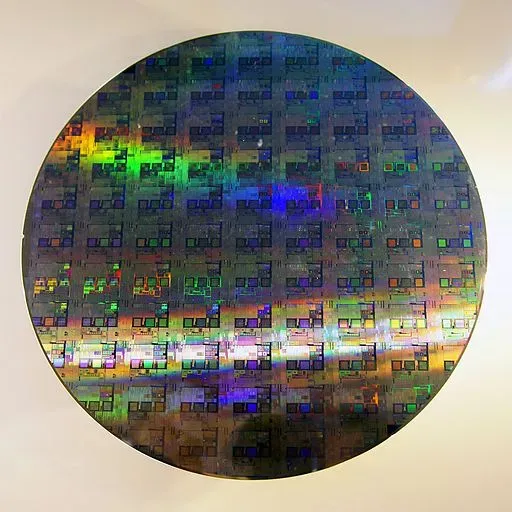
Labels such as “critical” or “conflict” sit alongside traditional geological descriptors like crystallographic structure or metamorphic grade.
A mineral is deemed critical when high economic or strategic importance collides with high supply risk. Because both market conditions and technologies evolve, the label is dynamic: a mineral may enter or exit a nation’s critical list as prices, trade patterns, or innovation trajectories shift. Coal is a good example of borderline critical material. Back in 2017, the EU Strategic Foresight Report didn’t consider it a “critical” material. But by 2023, because its use in steel production had grown and it had become more exposed to global market swings, it showed up on the list again.
“Conflict minerals” are minerals extracted in conflict-affected or high-risk areas where their trade finances wars or involves gross human-rights abuses. Current regulations focus on four metals—tin, tantalum, tungsten and gold (the “3TG”)—because they are common in electronics and jewellery and were widely linked to armed groups in and around the Democratic Republic of Congo.
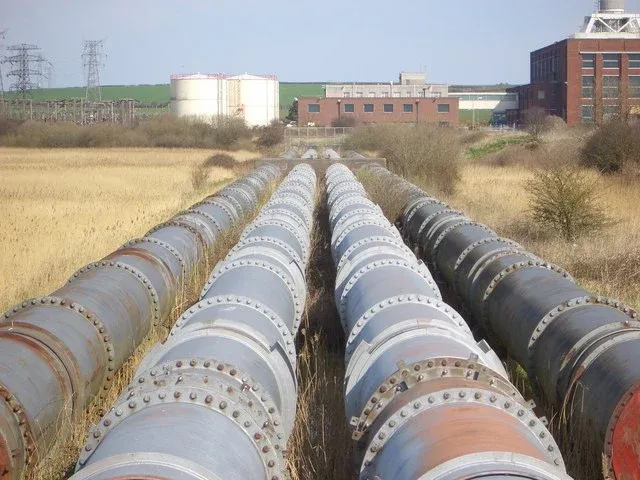
Whenever we talk about “digital,” we’re really describing a full journey: starting with raw chunks of Earth crust, turning that into engineered hardware which enables software running on gigawatts of energy, eventually ending back into our planet’s depths as waste.
Library
A library is more than a roomful of catalogued objects; it is an institutional hack on the economy. By lending rather than selling, libraries let people borrow and use creative works without ownership.
They suspend the default rules of property and profit, turning scarcity into shared access—what Evgeny Morozov calls “an economic model that knows which rules to bend.”
Our Digital Materials Library focuses on curatorial tasks: to select, to classify, to cross-reference—hoping to rethink extractivism and move toward stewardship.
If mineral reserves are a public collection instead of a colonial frontier, how will we check materials out—and what do we give back when they are overdue?
Digital Materials Library Website
Created by An Diep Vo, Andrea Provenzano, Josie McGarvey, Jöhan Markus Ludvigsen Utnes, Maja van der Velden, and Andrea Gasparini for the Sustainable Futures Lab at the University of Oslo.
To open the digital materials library, you can open it in fullscreen via the link. Below are the instructions for use of the library.
Open Digital Material Library in Fullscreen
1. Zoom

Use the + and – buttons or scroll to zoom.
Click Zoom Fit  to reset and center the view.
Lost? Use Zoom Fit to reorient.
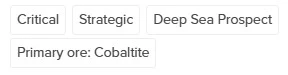
2. Tags
Tags like Critical, Rare Earth, etc. help you explore related items.
3. Search
Use the top search bar to find any material or technology.
It can also help you discover hidden pages,
such as:
- "Country Highest Production"
- "Critical vs non-critical"
- "Deep Sea Mining"
- "Economic Importance"
- "Explanation on mineral, stone, rock, ore, element, material"
- "Material: Mercury"
- "Material: Silicon Dioxide"
- "Material: Sodium"
- "Material: Uranium"
- "Platinum Group Metals"
- "Rare Earth Elements"
- "Recycling"
- "Rock to metal ratio"
- "Stories - El Escobal Mine"
- "Supply Risk"
- "Total Global Production"
- "World Reserves"
Project Team
Project Leaders and Researchers
- Prof. Maja van der Velden
Dept. of Informatics
Project leader - Dr. Andrea Gasparini
University Library
Project leader
Master students
- Jöhan Markus Ludvigsen Utnes ('24-'26)
- Eirik Johan Langholm ('23-'25)
- Sara Prestvik Kristensen ('22-'24)
PhD Candidates
- Siv Årsand
PhD candidate
Summer Students
- An Diep Vo (2025)
- Andrea Provenzano (2025)
- Josie McGarvey (2025)
- Jöhan Markus Ludvigsen Utnes (2025)